





Nonwovens support Renault’s net zero target
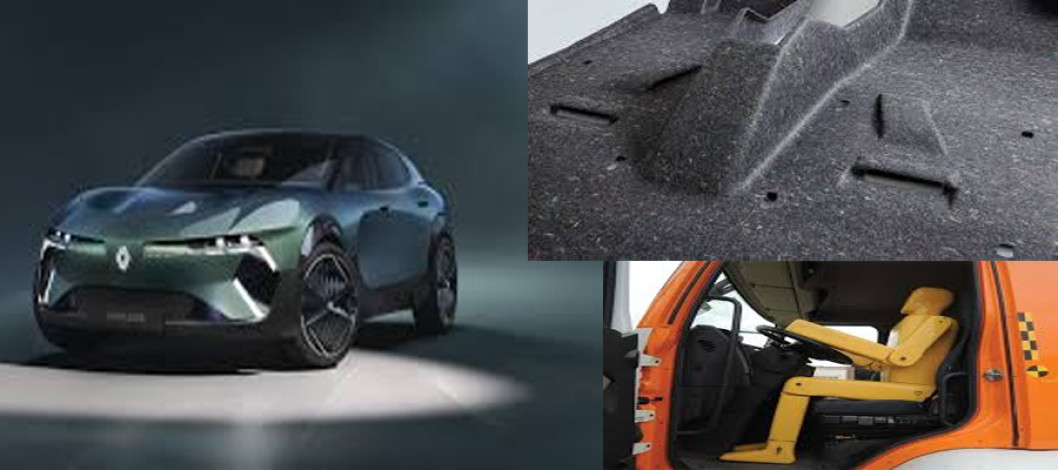
Among many other planet-friendly firsts, the just-unveiled Renault Emblème – described as “a laboratory on wheels for low-carbon mobility” – demonstrates the ongoing importance of nonwoven fabrics to the automotive industry.
No aspect of decarbonisation can be studied as an isolated issue, says Renault, and any approach has to address the entire life cycle of a vehicle from cradle to grave in five key areas – eco-design, the selection of resources, production, the vehicle’s use, and its end of life.
The combined electric/hydrogen Emblème is the French car manufacturer’s vision of a low-carbon family car from start to finish, emitting 90% less greenhouse gases over its entire life cycle than a comparable baseline model from 2019. It has achieved a 70% reduction in the carbon footprint for the production of all of its parts, and 50% of the materials used to build it are recycled. In addition, virtually all of the materials used are recyclable at the end of their service life, and engineers and designers worked together to find the best solutions in terms of aerodynamics and energy efficiency.
Stringent specifications
Every technical, technological, and stylistic choice was dictated by stringent specifications, targeting new levels of low-carbon mobility, and more than twenty partners – all experts in their own fields – worked on the project led by Ampere, Renault’s subsidiary dedicated to the development of intelligent electric vehicles.
A vehicle’s weight impacts its emissions at several levels – when materials are extracted, in production and transport, during use, and when the vehicle is recycled. To limit the weight of the Renault Emblème to just 1,800 kilos, designers sought to shed every unnecessary kilo while maintaining the quality of on-board features.
Weight savings in the cost-effective replacement of other materials is where nonwoven fabrics simply excel.
Thermal and acoustic insulation
Among key suppliers involved in the development of the Emblème was Winterthur, Switzerland-headquartered components manufacturer Autoneum, a major user of nonwovens.
Autoneum designed no less than 32 parts for it – both inside and outside the vehicle – for single-material thermal and acoustic insulation. These included the underbody fairing, the floor mats, the boot liners, acoustic parts, powertrain compartment absorbers, and front storage, which were all made from single-material polyester fibres, which are extremely light and easy to recycle.
In a notable trend in recent years, densely needled nonwovens have been appearing on the exterior of vehicles as undershields to achieve a 50% weight saving compared to heavier hard plastic structures. Nonwoven battery undercovers are a logical extension of these undershields.
Autoneum’s waste-free production processes for the Emblème parts made maximum use of renewable electricity and recycled off-cuts, and based on weight savings of 25%, a high level of recycled content, a waste-free production process,s and the recyclability of end-of-life materials, was able to reduce the overall carbon footprint of its components by 70%.
The dual-energy electric powertrain under the rear floor is powered by electricity and hydrogen – an ideal combination for more low-carbon journeys over both short and long distances – and all batteries and the hydrogen tanks are housed in protective nonwoven packages.
Natural fibres
The single-fibre policy for the Emblème extends to the seat fabrics and floor covering in the interior of the vehicle, but elsewhere, flax has been incorporated into nonwoven reinforcements for composite parts such as the door panels and is also employed as upholstery on the dashboard.
The use of nonwoven reinforcements based on wood and flax in door panels has made a major contribution to reducing the weight of vehicles since their first use in the Mercedes-Benz E class thirty years ago.
Pineapple leaf fibres have also been used for the upholstery of the Emblème, as a nonwoven-based natural alternative to leather featured on the contact zones of the door panels and the central console.
These natural fibre materials act as carbon sinks, capable of storing CO2.
For the door inserts and dashboard strip, an assembly process has been optimised, eliminating the need for welding or gluing, to enable easier recycling.
Source: Online/NAN




Comment Now